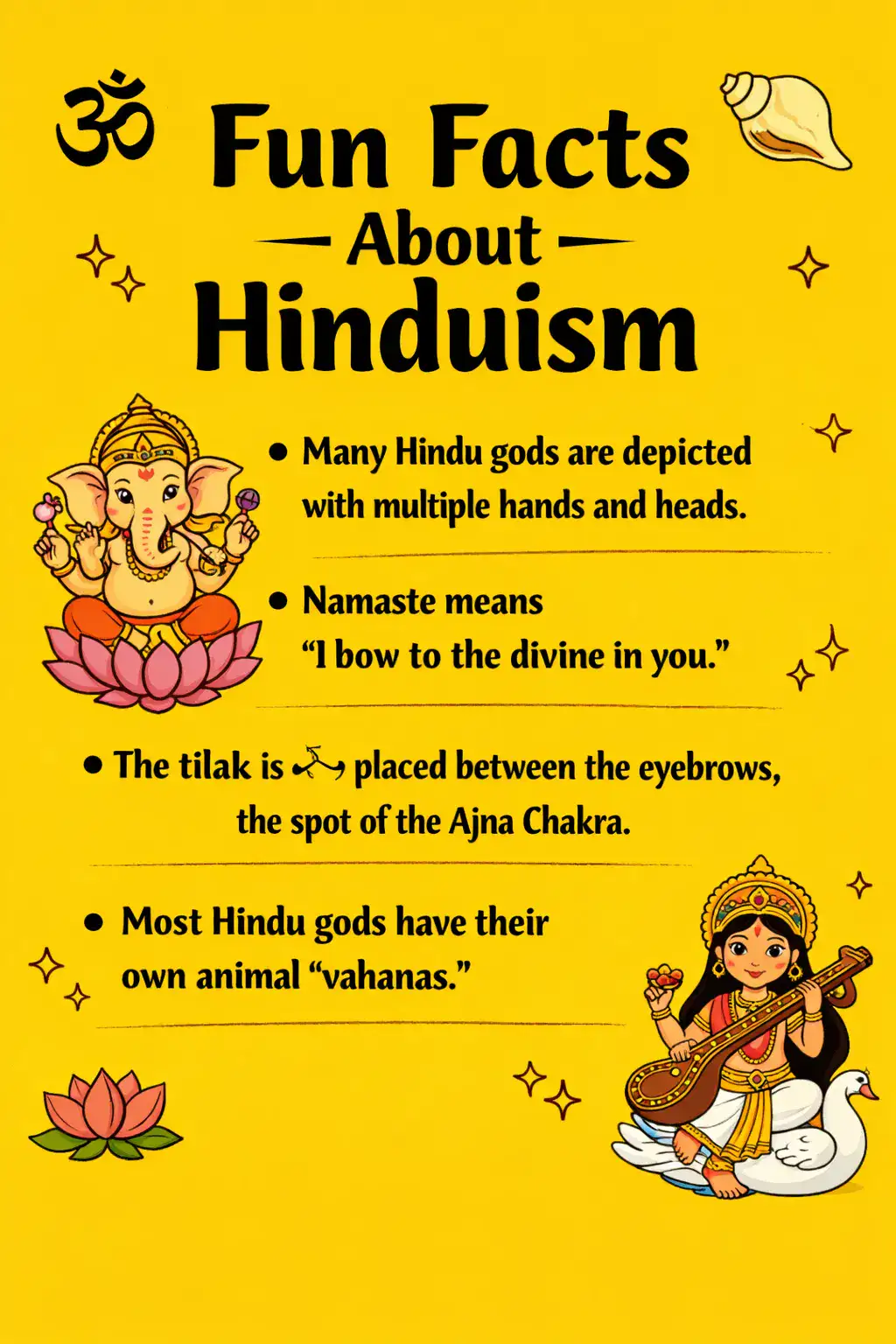
Hinduism is one of the major religions in the world. It is also the most ancient culture with presence in many countries. Following are some of the fun facts about Hinduism
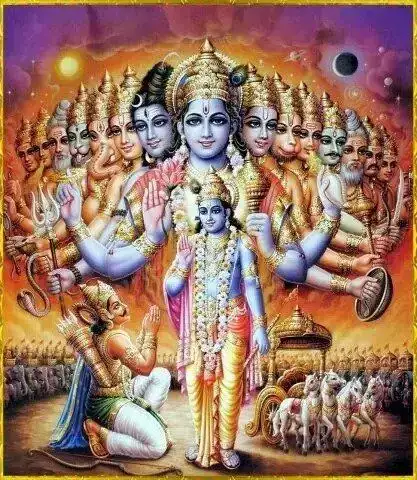
1. Many Hindu gods are depicted with multiple hands and heads.

Many Hindu gods and goddesses, like Vishnu, Ganesha, Lakshmi, Saraswati, etc., are depicted as having multiple hands. Some of the gods like Kartikeya, Brahma are depicted as having multiple heads. Symbolically, multiple hands symbolize different abilities or weapons a deity controls. Multiple heads represent various aspects of knowledge or cosmic functions.
Some believe these features are metaphorical rather than literal descriptions of the gods, but it is not impossible that these features are real as gods have divine powers.
2. According to Rigveda, Indra is the most powerful god but Hindus don’t worship him.

In the Rigveda, Indra is praised as the king of gods and the slayer of Vritra. He appears in more hymns than any other Vedic deity, showing his importance. He is also compared to Brahman, the supreme God in Hinduism in some verses. However, in modern Hindu worship, his prominence has greatly diminished. Most Hindus don’t worship him because of a curse to him. Only a few regional rituals and festivals still honor him today.
3. Cow is the most sacred animal, but many other animals are also considered sacred.

Per the Puranas, the cow is the most sacred animal and killing her is one of the deadly sins in Hinduism. Many Hindu gods, like Lord Dattatreya, Krishna are linked to her. However, Hinduism also assigns sacred roles to many animals such as monkeys, snakes, bulls, etc. Each animal is linked to specific gods, stories, or cosmic symbolism. This reflects the belief that divinity exists in all forms of life.
4. Namaste means “I bow the divine in you”.

Most Hindus great each other by joining their palms and saying Namaste. It is a traditional greeting in Hindu culture. Namaste is a Sanskrit word. Its literal meaning is “I bow to you,” but spiritually it implies acknowledging the divine within others. The gesture of bringing palms together reinforces respect and humility.
5. The tilaka on the forehead is placed between the eyebrows, which is the location of the Ajna Chakra.
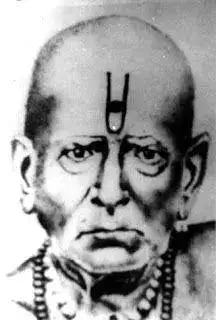
The tilaka or bindi is often applied to the spot between the eyebrows. This point is traditionally considered the Ajna Chakra, the centre of intuition. Placing a tilak here is believed to enhance focus and spiritual awareness. It also has cultural, ritual, and protective significance in Hindu traditions.
6. Hinduism is monotheistic, polytheistic as well as henotheistic.

Hinduism includes belief in one supreme reality known as Brahman. At the same time, it features devotion to many deities with different forms and functions. They believe that gods are manifestations of Brahman in different forms. Henotheism appears when a worshipper treats one specific deity as supreme without denying others. This flexibility is one of Hinduism’s unique philosophical strengths.
7. Most of the Hindu gods are associated with separate animals known as their vahanas (carriers).

A vahana is a divine vehicle that symbolizes a god’s power and qualities. Examples include Garuda for Vishnu, Nandi for Shiva, and the mouse for Ganesha. These associations are deeply rooted in mythology and iconography. These vahanas are divine and carry special powers also. It is also a way to intertwingle nature and humans.
8. Many Hindu gods are associated with musical instruments.

Some of the Hindu gods are associated with musical instruments. E.g., Saraswati is linked with the veena, representing knowledge and art. Shiva holds the damaru, symbolizing creation through cosmic sound. Krishna’s flute expresses love, devotion, and divine play. These instruments serve as symbols of spiritual, artistic, and cosmic expression.
9. Lord Brahma is the creator of universe but he is not commonly worshiped.

Brahma, as part of the Trimurti, is recognized as the creator deity. Despite this role, only a few temples in India are dedicated to him, notably one at Pushkar. Because of a curse upon him, his worship in separate form is prohibited.
10. Approximately 9/10 Hindus in the world live in India.
India is the primary homeland of Hinduism and holds the largest Hindu population. There are more than 1 billion Hindus in India, which is equal to nearly 94 percent of Hindus in the world. The religion is also practiced across Nepal, Bangladesh, and other regions. Its diaspora has expanded worldwide in recent decades.
11. Hindus in the U.S. and Europe are among the most educated religious groups where they live.
Studies show Hindu communities in Western countries have high educational attainment. Many hold university degrees and work in professional sectors. This trend is attributed to migration patterns and emphasis on learning. As a result, Hindus often rank among the top educated groups in these regions.
12. Hindus worship gods mostly in image/idol form.
Murti puja, or worship through images, is central to many Hindu traditions. Images serve as focal points for devotion, meditation, and ritual offerings. They help worshippers connect with divine qualities in a tangible way. However, formless worship also exists in philosophical schools like Advaita.
13. Hindus worship gods, trees, animals and sometimes demons, ghosts as well.

Hindus believe that God is in each atom of the universe. Hinduism values the sacredness of nature, including trees like Peepal and Tulsi. Animals such as snakes, cows, and monkeys receive ritual respect. Some folk traditions include offerings to spirits or local deities to maintain harmony. This reflects a worldview in which divine forces operate at many levels. In some Hindu temples, the demons that are killed by gods are also honored. There are a few separate temples dedicated to asuras, like Ravana, although the spirit/asura worship is rare.
14. History of Hinduism can be traced back to 5000-10000 years.
Archaeological and textual evidence places Hindu roots in the Indus Valley era. Many scholars trace the Vedic tradition to over 3,500 years ago. Broader cultural practices may date back 5,000 years or more. Some traditional interpretations extend Hindu history to 10,000 years.
15. Hindus worship gods in both male and female forms.

Hinduism recognizes divine masculine forms such as Shiva and Vishnu. It also celebrates powerful feminine forms like Durga, Lakshmi, and Saraswati. The concept of Shakti emphasizes the importance of the divine feminine. This balance reflects the belief that creation requires both energies.
If you know more fun facts about Hinduism, please let us know using the Comments section.