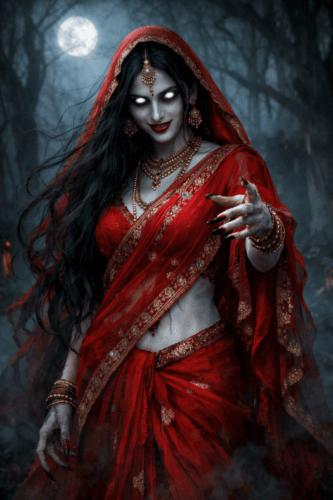
The most popular types of female ghosts in India are chudail, dayan, yakshi, naale baa, and pishachini. Other than these, there are many different types of female ghosts mentioned in folklore. India’s supernatural traditions are among the richest in the world, shaped by thousands of years of myth, regional customs, and oral storytelling.
Bollywood has played a significant role in popularizing female ghosts in India by showing a female ghost wearing white clothes, carrying a candle, and walking on a deserted road. Hundreds of movies have been made so far on female ghosts, and it is still a popular subject.
Types of Female Ghosts in India:
1. Churel (Chudail):
One of the most popular female ghosts in India, the churel is often described as the spirit of a woman who died during childbirth, during menstruation, or a violent death. It is believed that she has long pointed nails, long unkempt hair, and backward-facing feet. Sometimes, she takes the form of a young, beautiful woman to lure men and kill them.
The word chudail is used interchangeably for dayan, which is a different type of ghost in India and is also very popular.
In several stories, she appears near roads, farmland, or boundary areas, luring unsuspecting men. Some believe they live on tamarind or mango trees. The backward feet serve as a warning to observers. Many folktales also portray her as a guardian of women’s honor, punishing men who behave unjustly.
2. Dayan:
Dayan is another popular type of female ghost in India. Dayan is the spirit of a woman who observed black magic/sorcery when she was alive. Their ghosts are more powerful because of their knowledge about witchcraft.
The words chudail and dayan are often used interchangeably. The main difference between them is that a chudail has unkempt long hair while a dayan has braided long hair. Also, a chudail has reversed feet. Beliefs change from region to region. The term dayan is more popular in areas of Rajasthan, Bihar, Jharkhand, and tribal regions.
Sometimes a living woman who practises witchcraft is also called a dayan. There have been many incidents in India where such women were burnt alive by mobs suspecting them of practising black magic. Such women generally live in outskirts.
3. Yakshini/Yakshi:
Yakshi is a female ghost popular in South India (mainly in Kerala and Tamil Nadu). Unlike many ghosts born from tragic circumstances, yakshinis are supernatural beings rooted in ancient Hindu and Buddhist mythology. They are not exactly ghosts but are supernatural beings. They are often depicted as enchantingly beautiful women who inhabit forests, trees, and riverbanks.
In Kerala’s lore, yakshi is both alluring and deadly. She appears as a charming woman seeking help, only to kill or drink the blood of the person who shelters her. She has qualities of both a chudail and a pishachini.
4. Pishachini:
The pishachini is a terrifying female pishacha associated with haunted crossroads, cremation grounds, or desolate areas. She has long nails, glowing eyes, and sometimes an animal-like face. Unlike some female ghosts who arise from tragic circumstances, pishachinis are often portrayed as ancient demonic beings.
They are believed to be flesh-eating and blood-drinking spirits. In certain local traditions, a woman can become a pishachini if she dies with deep hatred or after engaging in occult rites gone wrong.
According to the Mahabharata, the original pishchas were created by Lord Brahma.
5. Mohini/Mohana:
The Mohana or Mohini ghost is a spirit of a young woman who died without experiencing love or was betrayed in love. They are described as beautiful women dressed in white.
She lures men by her beauty and kills them after fulfilling their desire. She appears near water bodies, coconut trees, and dense forests. She shares many similar characteristics with a chudail.
6. Dakini:
In Tantric and yogic traditions, dakinis are not ghosts but spiritual beings associated with esoteric practices. However, in popular rural folklore—especially in Rajasthan, Himachal Pradesh, Maharashtra, and Bengal—the dakini is reinterpreted as a vengeful spirit of a woman killed through black magic or sacrificed in occult rituals.
These spirits are believed to assist tantriks in their travels at night and inhabit cremation grounds. They symbolize both fear of the occult and the idea that wrongful death creates powerful, restless spirits.
She has many characteristics similar to a dayan. It is believed that she does black magic on the victim. Sometimes, she winds a thread around a banyan tree to cause harmful effects to the victims.
7. Preti or Pretani:
The term preta generally refers to a hungry and restless ghost. A preti is the spirit of a woman who was corrupted, jealous, and greedy in the previous life. As a result, they are afflicted with insatiable hunger. She is often thin, hungry, and wandering, representing dissatisfaction and unfulfilled karmic cycles.
Folklore describes preti as harmless unless provoked, but her presence signals unresolved family issues or improper funeral rites. This ghost is often invoked in rituals meant to honor ancestors.
8. Petni (Bengal):
In Bengal, the petni is one of the most detailed female ghost archetypes. Typically, she is the spirit of an unmarried woman who died young. Petnis often dwell near rivers, trees, or cremation sites and may take on grotesque appearances, such as very long limbs or distorted faces.
The cultural root of the petni legend lies in societal emphasis on marriage as a fulfillment for women. Her ghostly existence reflects the sorrow of dying before achieving what society considered a crucial milestone. Some regional stories, however, portray her as protective of certain areas, warning villagers of danger. She is similar to a churel in many characteristics.
9. Muni:
Based on South Indian folklore, Muni is a type of ghost that is described as a guardian or territorial entity associated with specific places, particularly lonely places. They are generally harmless but can be harmful if disturbed.
Unlike other ghosts, Muni appears during the daytime, particularly at noon. They slap or attack people who enter their territory. They like non-veg food more and sometimes attack those who carry it.
10. Banachandi or Forest Goddess Turned Spirit:
Several tribal communities from central and eastern India describe the spirits of women who become guardians of forests after death. Not all of these entities are malevolent—some act as protectors of wildlife and forest boundaries. When angered, however, they manifest as fierce apparitions.
These spirits represent ecological reverence, the sacredness of nature, and the belief that certain women—especially priestesses or tribal leaders—retain spiritual authority even after death.
11. Sankhini/Sankhachurni:
In Odisha, Bihar, and Bengal, the sankhini is the ghost of a married woman who dies due to tragic or unjust circumstances. She typically appears wearing conch bangles and red corals, which are symbols of a married Hindu woman.
They have unfulfilled desires of living a married life; hence, they target young, married women. They have strong cravings for fish.
12. Pontianak:
Pontianak is a female ghost of a woman who died during childbirth. It is believed that they are mostly active at night and rest inside banana trees during the day. They kill their victims by tearing their stomachs with their sharp nails and devouring their organs.
They are described as having pale skin, long hair and nails, and wearing white dresses. To kill them, you must plunge a nail into their neck.
13. Chhalava:
Chhalava is a shapeshifting female ghost who appears as a beautiful woman in a white dress and lures travelers. Sometimes, it appears as children or both. They are linked to the tragic deaths of unmarried women or a young child.
Its primary goal is to confuse travelers and lead them to deep forests or isolated areas. Some of them are harmful and kill their victims by leading them astray.
14. Jakhin:
Jakhin is a female evil spirit who lives in forests or isolated places. She attracts children and males to kill them or absorbs their powers. Her stories are popular in the Konkan region of Maharashtra.
15. Ratha Katteri:
It is a type of female vampire popular in Tamil folklore. She is described as a vampire who drinks blood from her victims’ bodies. She is often described as a shadowy figure with a blood-stained baby in her mouth.
It rests in a big banyan tree. Some people worship her as a goddess/protector of their family.
16. Naale Baa/Hakamari:
The legend of Naale Baa became very popular in India as the story was used in a blockbuster Bollywood movie named “Stree”. The same ghost is known as Hakamari in Maharashtra.
It is a female ghost/witch who calls the names of the people living in the house at night in their beloved people’s voices. If a person replies, then he/she will die of a heart attack or by vomiting blood.
To prevent the ghost from calling, people used to put an “x” sign on the doors in Maharashtra, while the people in Karnataka used to write “naale baa” on their doors. Naale Baa literally means “come tomorrow”. The word Hakamari literally means “the one (female) who calls.”
Conclusion:
Females are physically weak and are often victims of injustice in many cultures. Therefore, it is obvious that most of them have unfulfilled desires and want revenge for the injustice done to them. That is why you find so many types of female ghosts in India.
The female ghosts of India are more than frightening apparitions. They embody moral lessons, social commentary, ecological symbolism, and psychological archetypes. From the churel’s warning about mistreating women to the yakshini’s representation of natural power, each spirit carries a cultural message. Their stories endure because they resonate with collective fears, injustices, and beliefs that have shaped Indian society for generations.
You May Also Like To Read: Brahmarakshasa
I have reviewed the material presented there, and it reflects an earnest attempt to document cultural beliefs with attention to the variety and specificity that different traditions bring to the idea of spirits and the unseen. The writing does not merely offer a list, but seeks to situate each category within the broader patterns of folklore, reminding the reader how stories of female ghosts in India are shaped by history, region, and symbolic meaning rather than random invention. There is a steady respect for context, drawing on the rich tapestry of myth and popular imagination while avoiding unnecessary sensationalism. In its essence, it calls a man to recognize that cultural narratives about the otherworldly are not trivial curiosities, but expressions of collective concerns, values, and creative engagement with life’s mysteries, and that true understanding demands both respect for tradition and disciplined reflection on its deeper resonances.