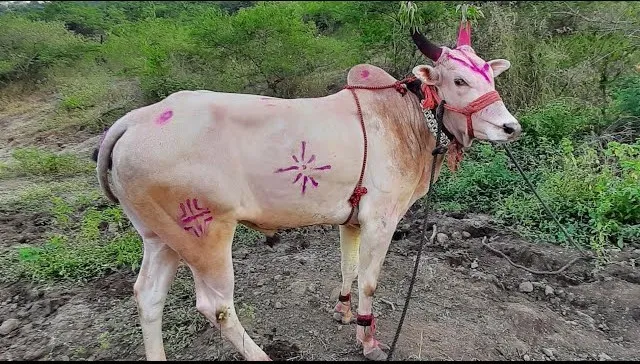
Bakasur, sometimes spelled Bakasoor or known by his earlier stable name Sarpanch, is a Khillar-type bull from Mulshi in Pune district, Maharashtra. He has become famous across the state for his consistent top finishes and many first-place wins in modern Bailgada (bullock-cart) racing events. Thanks to local owners, social media, and race videos, Bakasur is now a well-known name in Maharashtra’s bailgada community.
Name and Origin:
Bakasur belongs to the Dhumal family of Mulshi (Pune). Locally, he has also been called Sarpanch, which was his earlier stable name; the “Bakasur” nickname appears to have arisen after spectators compared his power and appetite to the demon from the Mahabharata, Bakasura, who is known for his insatiable hunger, and it stuck as a crowd-name that traveled with him across fields and shows.
According to another story, he got his name from a scene in a Marathi movie (Mulshi Pattern). In a scene from this movie, when Pravin Tarde is fighting with others, two children are shown eating like the demon Bakasur, without being aware of what is happening around them. It is believed that from this scene, he got his name, Bakasur.
The Bakasur Bail was not bought in any auction but was born to a cow bought by Mohil Dhumal’s maternal uncle from Chakan market.
What is the Breed of Bakasur Bail?
Its breed is Khillar. Khillar is a regional breed often prized in western India for strength and racing/working ability. Local writeups mention “four dānti” (four visible teeth), a phrase you’ll see in breed descriptions used by bailgada enthusiasts.
Who is the Owner of Bakasur Bail?
Mohil Dhumal (The Dhumal family) of Mulshi, Pune, is the owner of Bakasur.
Who are the Drivers/Trainers?
Vitthal Budhkar and Vaibhav Salunkhe are the current drivers/trainers—they appear in many video interviews and race captions as the people who handle the animal in competition.
Why Bakasur Stands Out — Style and Strengths:
- Explosive pace & gait: Bakasur’s most praised trait is a “tufani” (stormy/explosive) running style—quick acceleration from the start and a sustained, energetic pull that makes him dangerous in final sprints. Multiple race clips and interviews emphasize this feature.
- Body conformation: Local write-ups and owner interviews highlight Bakasur’s muscular frame and distinctive conformation, which fans say contribute to his race-winning capabilities.
Notable Victories, Events, and Honors:
Local reporting and community race coverage list a sequence of important wins and podiums that raised Bakasur’s profile in the state circuit. Prominent mentions include:
- Maharashtra Pusegaon Hindkesari 2022.
- Rustom-e-Hind (Sangli) 2023
- Pedgaon Arena Finals 2023
- Satara “Kesari” Palashi 2023
- Bhawanwadi Maidan 2023
- Koregaon Hindkesari
- Aadat Koregaon Hindkesari
Training, feeding, and breeding notes:
- Homebred origins: Local reporting claim Bakasur was born on the owner’s farm—he wasn’t bought at auction but raised from the family’s cows and trained alongside other stable contenders. That narrative is common in community write-ups and in interviews.
- Training basics in the bailgada world: While specific regiment details for Bakasur vary across interviews, typical practices mentioned by owners in these circles include regular sprint training on open tracks, careful fodder (high-energy grasses, millets, protein sources), and rest/conditioning between events. Owners often emphasize temperament training to keep the animals calm before a race.
Cultural context — why Bailgada racing matters (and how Bakasur fits)
- Bailgada events are rural sporting festivals in Maharashtra with strong community followings — part sport, part fair. They attract local crowds, organize competitions (sometimes with significant prize money and trophies), and receive heavy social media coverage by Bailgada fan channels. A standout bull becomes a local celebrity and, in some cases, a regional icon. Bakasur’s rise followed this exact pattern: strong local wins → social clips → wider fame.
- In Hinduism, a bull is considered the carrier of Lord Shiva and is revered. Bail Pola is a festival celebrated by farmers, mainly in Maharashtra, when they are given rest, fed sweets and their other favorite foods, and worshipped.
- Traditionally, bulls are used for doing many farm and non-farm work, but due to rapid mechanization, their need is decreasing, and many owners hesitate to keep them because of the increasing cost of their food and health. In this scenario, bullock-cart racing is playing a vital role in their conservation. Many farmers are raising them even if they don’t use them for farm work. It has become a source of earning and pride for them.