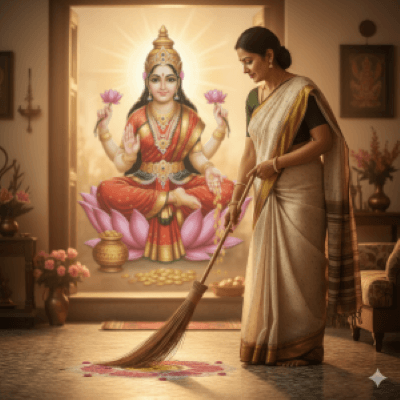
Hindus believe that a broom is an embodiment of Goddess Lakshmi, and one should touch it with one’s feet and not disrespect it in any way, as it brings bad luck and the person suffers financial losses.
This profound association stems from ancient beliefs rooted in the Indic philosophical reverence for cleanliness (Shauch), which is equated with godliness. Understanding this connection involves exploring the goddess’s nature, associated deities, specific purchasing and usage rituals, and the broom’s metaphorical role in maintaining purity—both external and internal.
The Core Connection: Cleanliness and Divinity
The fundamental link between the broom and Goddess Lakshmi is established through the principle that cleanliness is paramount for prosperity. Goddess Lakshmi is the epitome of purity and cleanliness. The traditional belief posits that Maa Lakshmi, the Goddess of wealth and prosperity, resides only in places that are neat and clean. Conversely, it is said that dirty places invite her elder sister, Alakshmi (or Daridra), the goddess of poverty, who brings trouble, debt, financial loss, and insecurity.
The act of sweeping itself is, therefore, seen as a sacred precursor to inviting good fortune. The broom’s ability to remove dirt and dregs is symbolically understood as clearing the path for Lakshmi’s blessings, while removing the home of Alakshmi.
Why is a broom associated with Goddess Lakshmi?
Behind most beliefs, there is always a story to tell in Hindu texts. The association of Goddess Laxmi with the broom also carries a story.
One day, Goddess Lakshmi, the consort of Lord Vishnu, took up a broom and began sweeping the golden halls of Vaikuntha, the eternal abode of Lord Vishnu.
When the celestial beings saw this, they were astonished. They asked her:
“Mother, why are you sweeping? Vaikuntha is already perfect, spotless, and self-luminous. Nothing here ever gathers dust!”
Lakshmi smiled and replied gently:
“It is not dust that I am sweeping away. By sweeping, I remove the dust of pride, ego, and arrogance that may arise in the hearts of devotees who enter Vaikuntha. Even here, humility must shine above all else. If pride takes root, it can separate the soul from divine love.”
She continued:
“By taking up the broom myself, I teach that no work is small. Service done with devotion purifies the heart. The Lord’s abode must be maintained with love and humility, not merely with wealth or grandeur.”
Lord Vishnu, watching this, was pleased. He said:
“Beloved, you show the highest truth: even the Goddess of wealth herself serves with humility. Let this be a lesson to all — that true greatness lies not in power, but in selfless service.”
Association of Broom with the Goddess Sheetala:
The connection extends beyond Lakshmi to other important feminine divine figures who symbolize purity and seasonal transition. Goddess Sheetala, who is worshipped in Hinduism, Buddhism, and some tribal cultures, is depicted holding a broom in her right hand. She protects the people from seasonal diseases and helps in smooth adaptation to the hotter months. She is considered the goddess of smallpox and other infectious diseases.
The Sisters: Lakshmi and Alakshmi:
The importance of the broom is further amplified by the relationship between Lakshmi and her sister, Alakshmi, the goddess of poverty. Alakshmi was known for being lazy, unkempt, discourteous, and wearing shabby clothes.
Once, Alakshmi complained to the gods:
“Everyone honors my younger sister Lakshmi, but no one respects me. Yet without me, people would not even value Lakshmi’s presence. Where is my place?”
The gods were troubled because no one wanted misfortune in their homes. Finally, they turned to Shri Krishna for a solution.
Krishna, full of wisdom, said gently:
“Alakshmi, you too have a role in the world. You will not reside where there is purity, devotion, and harmony — those are your sister’s domains. But you will live where there is filth, laziness, quarrels, greed, and disrespect. People will recognize your presence through conflict and poverty, and by correcting themselves, they will invite Lakshmi back.”
The broom serves as the tool to expel Daridra (dirt and impurity) and retain Lakshmi.
Ritual Practices and Festival Significance:
The broom assumes heightened religious significance during major Hindu festivals and within daily routines.
Diwali and Dhanteras: Welcoming Prosperity:
During Deepavali (Diwali), the festival of lights, and specifically on Dhanteras (Dhantrayodashi), the act of buying and revering the broom is a significant ritual. Purchasing a broom on Dhanteras is considered lucky and auspicious. This practice is believed to help the household get rid of all debts and bring happiness and prosperity. It is also explicitly considered a means to keep Goddess Lakshmi from leaving one’s home.
The festival preparation begins with Diwali ki safai (Diwali-cleaning), where homes are thoroughly cleaned, renovated, and decorated to remove negativity and welcome positivity. In some regions, a new broom is purchased and used for Diwali, and people symbolically worship the jharoo alongside Goddess Lakshmi with vermilion and turmeric on Lakshmi Pooja. Some devotees even donate brooms in temples on Diwali or clean temples continuously for 43 days to receive Lakshmi’s blessing.
When to Sweep the Home?
The broom is frequently used in Indian households daily. In rural India, the lady of the house picks up the jhadu at the break of dawn to clean the courtyard and porch. Sweeping the house during early morning hours is believed to invite Lakshmi to the home.
Conversely, traditional wisdom strongly advises against sweeping the house or mopping the floors after sunset. This custom is deeply rooted in the belief that Maa Lakshmi comes into people’s homes during the evening. Therefore, sweeping after dark is thought to risk sweeping away the presence of Maa Lakshmi. If cleaning is absolutely necessary in the evening, traditions suggest using a damp towel or cloth rather than a broom, and any collected dirt should be stored next to the trash can and disposed of the next morning, not discarded outside the home. Historically, this rule also held practical reasons, as sweeping in the dark without electricity made it easy to lose valuable items (wealth/Lakshmi).
(The logic behind not sweeping the house after sunset could be that in olden times, there was no electricity, and the visibility was limited. So one might sweep away valuable things unintentionally.)
Vastu and Spiritual Protocols: Dos and Don’ts
Due to its direct relation to prosperity and Maa Lakshmi, the broom is closely connected with Vastu Shastra. Following Vastu rules concerning the broom is essential for maintaining financial soundness. If a broom is improperly stored or oriented, it is believed to cause Vastu Dosh, leading to a decline in wealth and other issues.
Respect and Handling
The broom, as an embodiment of the Goddess, must be treated with reverence.
- One should never touch the broom with one’s feet. Accidentally touching it with one’s feet is considered improper or disrespectful.
- It is considered inauspicious to stamp on a broom.
- You should never hit an animal with the broom.
- A traditional superstition notes that a broom gets attached to the place it sweeps; thus, an owner should never take it along when moving to a new place to respect its sanctity and relation with the original location. However, taking a new broom to a newly built house is considered virtuous and auspicious.
Storage and Placement
Proper storage is key to retaining the Goddess’s favor:
- Brooms must be kept in a place not frequented by people.
- It should be stored in a secluded place away from sight.
- A broom should be laid flat on the floor; it must not be kept standing upright or inverted. Keeping it upright is associated with unexpected death in some homes.
- The broom should not be kept in the kitchen area, store room, or dining room.
- According to Vastu Shastra, the ideal storage direction is the north-west or west. The worst direction, which should be avoided, is the northeast.
- Leaving the broom outside on the balcony or terrace is considered disrespectful to Goddess Lakshmi.
Auspicious Buying Times:
Vastu Shastra provides specific instructions for purchasing a new broom to maintain a strong economic situation:
- The most auspicious days to buy a broom are Friday or Tuesday.
- Buying during Dhanteras and Diwali is also highly recommended.
- One should avoid buying a broom on Saturday (inauspicious, may bring financial problems) or Monday (may bring financial loss and hardship).
- It is inauspicious to buy a broom during Panchak.
- It is always advisable to buy a broom in Krishna Paksha (waning moon period), as purchasing it during Shuklapaksha (waxing moon period) is considered a sign of bad luck.
Beyond Wealth: Broader Spiritual Symbolism
The broom’s symbolism extends beyond material wealth to encompass internal and spiritual purification:
Inner Purity and Mind Cleansing
The act of sweeping resonates with the concept of internal purity. The broom symbolizes clearing away the cobwebs of unwanted ideas, notions, and perceptions. Symbolically, it is used to sweep out ego, greed, avarice, and anger from the mind, leading to prosperity when these negative traits are discarded.
This metaphor is echoed in Tantric practices, where brooms are sometimes used by healers to cure psychic problems, symbolizing the warding off of mental dirt.
The Principle of Non-Violence (Ahimsa):
In Jainism, the concept of supreme purity (Uttam Shauch) highlights the broom’s role in non-violence. Jain monks and nuns carry a broom with them—often a rajoharana or picchi (made of peacock feathers)—to sweep the ground before them. This prevents them from unconsciously killing insects or animals as they walk, affirming the sacred value of all living beings.
Conclusion:
Most of the Hindu beliefs carry hidden meanings. By associating Lakshmi with a broom, the importance of cleanliness is outlined. Even the lazy people make sure that they keep their households clean, as they know otherwise it might invite Alakshmi into their house.
The broom in the hand of Goddess Sheetala also teaches the importance of cleanliness. It is evident from it that ancient Indians were aware that dirtiness brings diseases.
The practice of honoring the jhadu emphasizes a broader lesson in Indic philosophy: the need to show reverence for all objects contributing to daily life and well-being. Because the world and everything in it is considered part of Brahman, nothing should be disrespected. By connecting this essential household tool to Goddess Lakshmi, its value and importance in sustaining health, happiness, and cleanliness are profoundly acknowledged.
Reference: Bhagwat Purana